
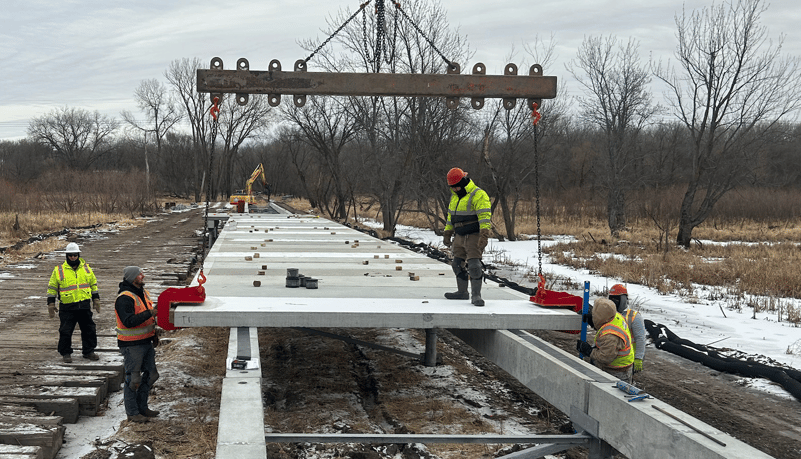
Helical piers continue to be one of the most common foundation types used in boardwalk construction. They install quickly, work well in various soil conditions, and limit disturbance in sensitive areas. But as with any flexible foundation system, the details—particularly how the system behaves under real load conditions—often govern how well the foundation performs.
While helical pier design is typically delegated to the pier supplier, we routinely review these designs and observe how they perform in the field. That experience gives us a clear picture of which considerations tend to drive real-world behavior.
Below are the critical structural considerations that most directly influence helical pier performance and should be evaluated as part of the helical pier design process.
1. Drift (Lateral Deflection) Criteria
Why it matters: One of the biggest drivers of perceived "movement" in a boardwalk is lateral deflection at the top of the pier. Meeting axial capacity alone is not enough; helical piers must also be designed for the lateral stiffness and deflection limits appropriate for elevated pedestrian structures.
Helical piers are often relatively slender compared to the overall system, which makes lateral stiffness and serviceability limits key drivers of performance. Even small horizontal movements can be felt by pedestrians, so controlling deflection at the pier head is essential.
Common sources of drift issues include:
- Overestimating horizontal soil stiffness
- Tall stickup heights (unbraced length of pier)
- Small shaft diameters with limited bending stiffness
We typically recommend that helical piers be designed for a maximum lateral deflection (drift) of 1 inch at the pier head. This helps ensure the foundation provides adequate stiffness for serviceability.
Lateral pile behavior is typically evaluated using software such as AllPile® or LPile®, which model soil–structure interaction and generate deflection, moment, and shear profiles for design verification.
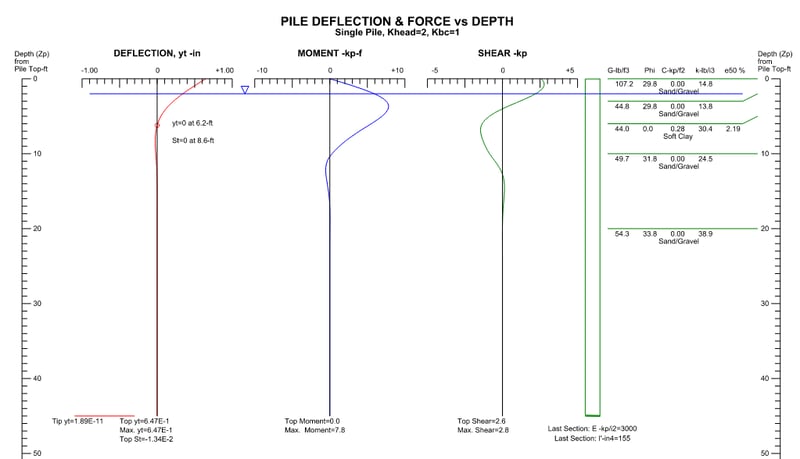
Example Allpile Output
Any helical design for a boardwalk should explicitly check lateral stiffness and deflection, not just axial capacity. That said, lateral deflection is only one part of the equation. Unbalanced load cases and geometric eccentricity also play a major role in how a helical pier performs.
2. Unbalanced Load Cases & Eccentricity
Why it matters: Unbalanced loading and geometric eccentricity create the same structural challenge: non-uniform moment distribution that drives lateral deflection and increases flexural demands on the pier shaft. These conditions create load paths that significantly influence shaft bending and overall deflection, even when axial capacity is satisfied.
Boardwalk loading is typically not uniform, and as a result, individual beam ends often attract disproportionately higher vertical or lateral demand during both construction and service conditions, which then transfers directly into the supporting pier.
Examples include:
- Eccentricity during construction
- Unbalanced Load After Construction (Service-Limit State)
- Eccentricity due to large span variations
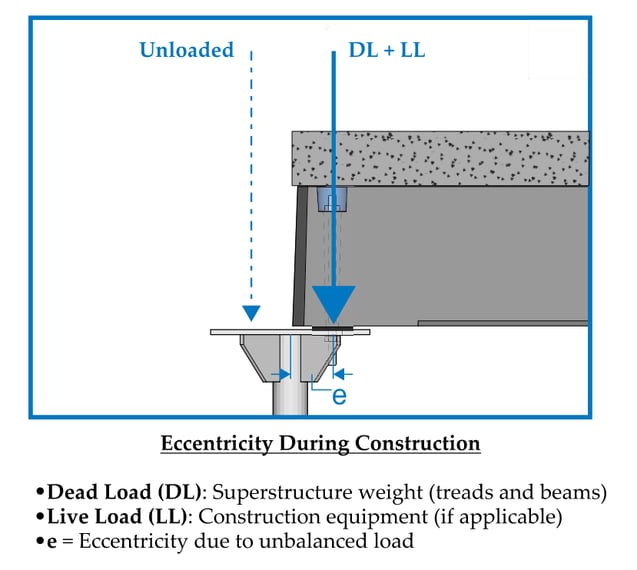
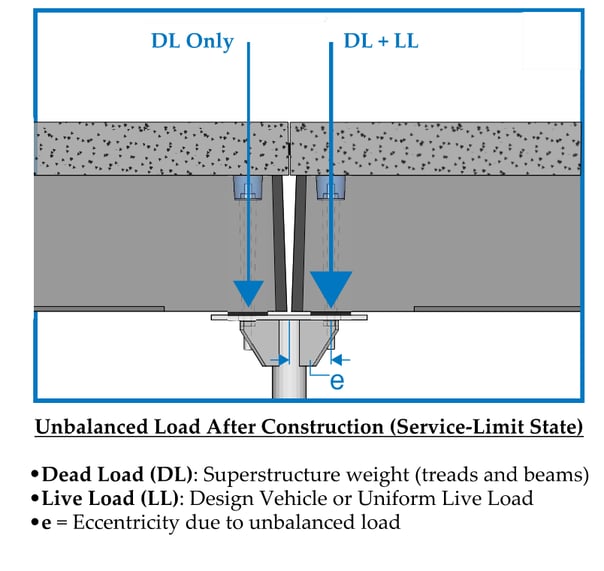
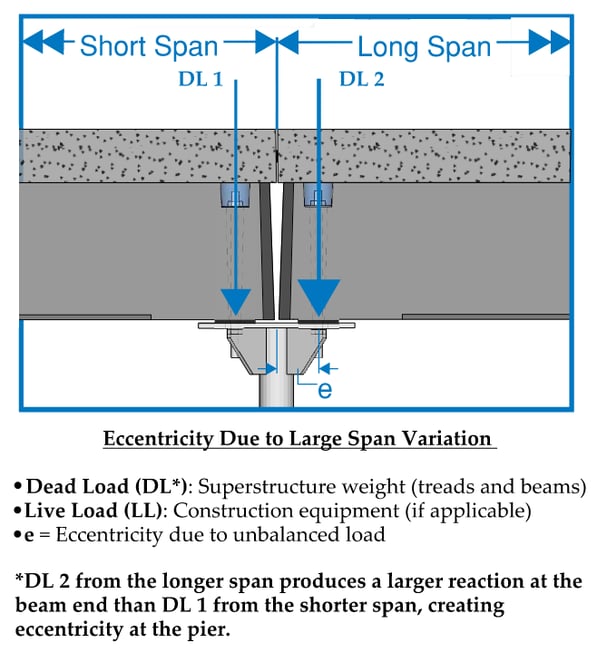
These three conditions represent the primary sources of eccentricity in boardwalk foundations. Each scenario introduces different moment demands into the pier, and each should be evaluated explicitly in design. The figures below illustrate how these conditions develop and the resulting load paths.
Eccentricity During Construction: The first scenario occurs during construction, when one span may be fully supported while the adjacent span is unloaded. This creates a temporary but significant eccentric load on the pier.
Unbalanced Load After Construction (Service-Limit State): After the boardwalk is in service, unbalanced live load on one span can produce similar eccentricity, even when dead load is uniform. This can govern lateral behavior during normal use.
Eccentricity due to large span variations: Large variations in adjacent span lengths can also shift reactions significantly to one side of the pier. Even with uniform loading, geometry alone can create eccentricity.
Designers should specifically consider:
- The longest span in any run
- Adjacent span transitions
- Tributary width differences
- Moment magnification from span variability
If the helical design does not explicitly check these conditions, the system is far more likely to exhibit noticeable movement after installation.
3. Shaft Size & Bracing Considerations
Why it matters: For boardwalks with exposed pier heights, shaft selection should prioritize bending stiffness over axial capacity alone. Standard shaft sizes often meet axial load requirements, but axial capacity has very little to do with how a pier performs laterally.
Selecting a larger shaft size can make a substantial difference in lateral performance, particularly near grade where bending demand is highest. A stiffer shaft reduces movement at the pier head and helps create a more stable experience for users.
Upsizing is often justified when:
- Pier stickup heights exceed 3–4 feet
- Lateral loads are significant
- Large span discrepancies exist
- Soils are soft or organic
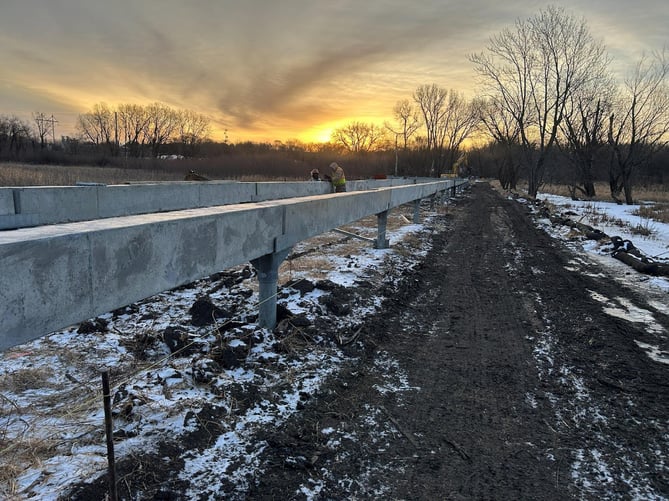
6” O.D. Helical Shaft at Minnesota River Greenway – Fort Snelling Segment, Minnesota
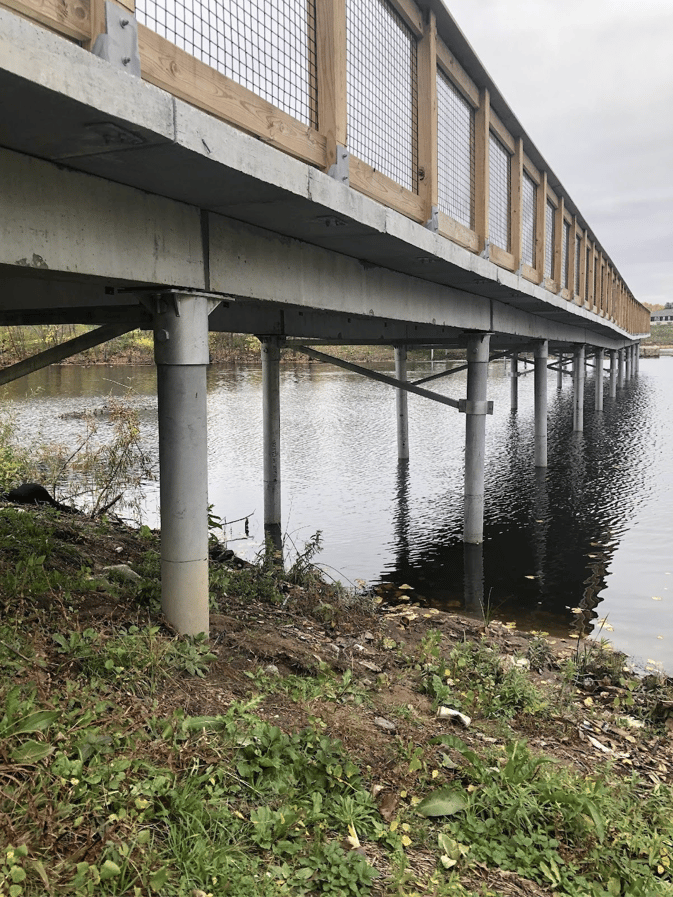
8 5/8” O.D. Helical Shaft with Bracing at Thompson Oaks Greenway, Minnesota
When constraints allow, increasing shaft diameter is typically an effective way to limit drift, and account for flexure due to lateral loads & eccentricity. However, bracing becomes essential when project geometry, access limitations, or height requirements make upsizing impractical.
Bracing systems that significantly increase stiffness include:
- X-bracing
- Chevron bracing
- Knee bracing
- Horizontal struts
Selecting a shaft size with adequate bending stiffness—not simply the minimum required for axial capacity—can greatly improve the boardwalk's perceived stability and long-term performance.
Design Checklist for Helical Pier Submittals
When reviewing helical pier designs for boardwalk applications, verify that the design explicitly addresses:
- Lateral deflection criteria – Maximum drift at pier head (typically 1 inch)
- Unbalanced load cases – Construction loading and service-level asymmetry
- Shaft bending stiffness – Adequate section properties for lateral performance
- Bracing requirements – When needed based on height and soil conditions
- Material specifications – Shaft thickness, corrosion resistance, steel grade
- Installation criteria – Torque requirements, installation tolerances
Closing Thoughts
Helical piers perform well in boardwalk applications when the design addresses lateral behavior, unbalanced loading, and shaft stiffness—not just axial capacity. Clear criteria, realistic load cases, and appropriate section selection go a long way toward avoiding the serviceability issues we see most often in the field.
It is also important that helical piers meet the material and installation specifications required for boardwalk applications. Details such as minimum shaft thickness, corrosion resistance, torque criteria, and installation tolerances all play a major role in long-term performance. PermaTrak also provides a sample helical pier specification that outlines recommended material and installation criteria and can be used as a reference when developing project-specific helical pier requirements.
Early coordination on drift criteria, load case selection, lateral performance expectations, and material/installation requirements provides a clearer design path and helps avoid the serviceability issues most commonly seen in the field.